Intervention Engine
The Value Acceleration Process
Most transformation programs fail in the mechanism, not the diagnosis. VAP is the mechanism. Three steps, repeated at any scale, that turn what's wrong into what's getting better.
The Problem VAP Solves
Organizations are reasonably good at identifying what is wrong with them. The diagnostics in Applied Agility, the Three Barriers and the twenty-three named gaps, give leaders a vocabulary for naming dysfunction at the level of specifics. That is not where transformation programs fail.
They fail in the mechanism. The gap between “we know what’s wrong” and “things are actually getting better” is where transformation efforts go to die. Consulting engagements produce recommendations that sit in slide decks. Training creates enthusiasm that fades within weeks. Reorganizations shuffle boxes without changing how work flows. The diagnosis was accurate. The mechanism for acting on it was missing.
The Value Acceleration Process, VAP, is that mechanism.
VAP isn’t a framework you adopt or a methodology you install. It’s an operating rhythm.
The Three Steps
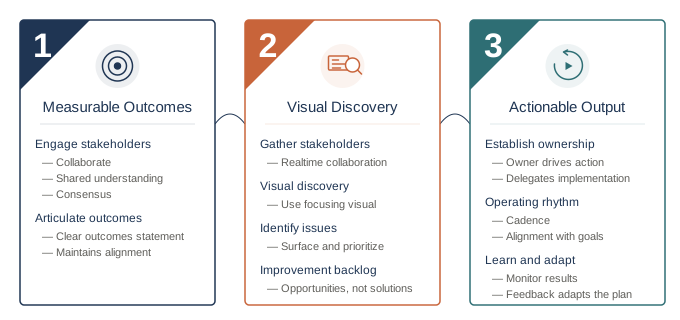
VAP follows three steps, applied in sequence. The pattern is the same at every scale: a team running a retrospective, a value stream group improving flow, an executive group governing an enterprise transformation. The scope changes. The mechanism does not.
Step 1: Establish Outcomes
Every improvement effort needs an anchor. Without a clear outcome, activity drifts toward whatever feels urgent or whoever speaks loudest.
Establish Outcomes is the discipline of defining what success looks like before diving into problems and solutions. The step begins by engaging stakeholders: the people who have context on the problem space, authority to act on findings, or accountability for results. From that engagement, you articulate outcomes: specific, measurable results the improvement effort aims to produce. Not activities. Not outputs. Outcomes.
A well-articulated outcome becomes the filter for everything that follows. When discovery surfaces a dozen potential issues, the outcome tells you which ones matter. When action planning generates competing ideas, the outcome tells you how to prioritize.
The failure mode is skipping this step or treating it as a formality. Teams eager to fix things jump straight to solutions. Leaders with strong opinions anchor on their preferred answer before the problem is framed. When outcomes aren’t established, improvement efforts solve the wrong problems efficiently. The signature symptom: a project completes on time and on budget, and nobody can explain what actually got better.
Poor outcome: “Implement agile practices.” Better: “Reduce time from customer request to deployed capability by fifty percent.”
Poor outcome: “Improve cross-team collaboration.” Better: “Eliminate cross-team handoff delays that currently add three weeks to delivery cycles.”
The difference is consequential. Activity language describes what you are going to do. Outcome language describes the change in the world that will be different when you succeed.
Step 2: Conduct Discovery
With outcomes established, discovery answers a different question. What stands between where we are and where we have agreed to go?
This is where obstacles, bottlenecks, and opportunities surface, not from a single expert’s analysis but from the collective intelligence of people who see different parts of the system. The product manager knows customer needs but not deployment constraints. The architect understands technical dependencies but not capacity realities. The delivery lead sees team dynamics but not portfolio pressures. Discovery brings these partial views together. The collisions are where insight emerges.
Discovery is structured by a focusing visual: a representation of the problem space that prevents blank-slate brainstorming from drifting toward whoever speaks first or loudest. The visual grounds the conversation in the actual domain being improved. It might be a value stream map, a process diagram, a system architecture, or a customer journey. The specific visual depends on the scope. What matters is that it represents the actual system, not an abstract canvas. When no domain-specific visual fits, a generic Effort by Impact matrix serves as a fallback.
Discovery concludes by producing two things: an ordered improvement backlog and the execution mechanism that will work it. The backlog is a prioritized list of improvement opportunities, not a list of solutions. Top items run first. Each item names where outcomes are not being met. What to actually do about it is formed in Step 3, where the opportunity becomes the hypothesis for an experiment. The backlog without the mechanism is a wish list. The mechanism without ownership is a calendar invite.
The failure mode is unstructured brainstorming that produces a sprawling list of grievances and pet projects, disconnected from outcomes and impossible to prioritize. Without structure, discovery becomes venting. With the wrong structure, discovery becomes an exercise in confirming what the loudest voice already believed.
Step 3: Take Action
The backlog from Discovery is a list of improvement opportunities, not solutions. Take Action turns each opportunity into a testable hypothesis and runs it as an experiment.
This is where most improvement efforts fail, not because the diagnosis was wrong, but because the organization treated the solution as a project to be managed rather than an experiment to be tested. A long initiative is funded, staffed with a committee, and left to run. By the time anyone realizes the approach isn’t working, the budget is gone and the political cost of stopping is too high. The initiative becomes a zombie. Shuffling forward, consuming brains and budget, dead on arrival.
VAP shifts the operating model from implementation to validation. You are not rolling out a solution. You are placing a portfolio bet.
Traditional governance asks: “Are you on schedule?” VAP governance asks: “What have you learned, and should we keep funding this?”
Action runs on portfolio experiments, not transformation rollouts. The improvement backlog is worked one experiment at a time, sized small enough that a failure costs one cycle, not one fiscal year. Each experiment is owned, scoped, time-boxed, and pointed at a specific outcome.
The decision at the close of each experiment is Kill, Pivot, or Persevere:
- Kill. The hypothesis was wrong. Stop the work. Reclaim the capacity.
- Pivot. The hypothesis was right, but the execution needs adjustment. Change the approach and run another cycle.
- Persevere. The experiment worked. The data proves value. Now, and only now, authorize broader rollout.
Who makes the Kill/Pivot/Persevere call depends on altitude. See VAP at Different Altitudes below.
How VAP Iterates
Two distinct iteration loops keep VAP an ongoing rhythm rather than a one-shot exercise.
The outer loop: VAP repeats
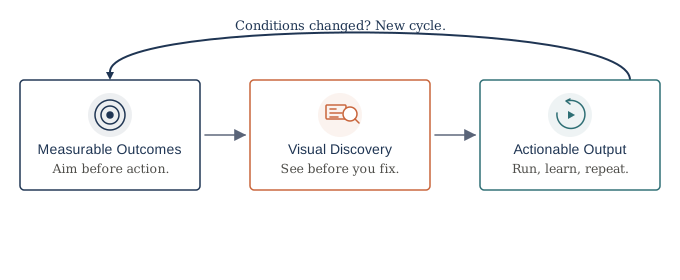
Once a VAP cycle completes, the question isn’t “what’s next on the project plan?” The question is whether conditions have changed enough to run the cycle again. Two flavors:
- Outcomes need reconsidering. The strategic context shifted: a market move, a regulatory change, a new constraint, a successful experiment that opens new possibilities. The next cycle re-enters at Step 1.
- Outcomes hold; discovery would benefit from a fresh pass. The destination is still right, but the landscape between here and there has changed. New obstacles surfaced. Old assumptions broke. The next cycle re-enters at Step 2.
How that check happens is operational, not part of the mechanism itself. Some organizations run VAP on a cadence (quarterly, monthly, every retrospective). Some run it on demand when a triggering event hits. Many do both: a regular cadence as the baseline, on-demand cycles when conditions warrant.
The inner loop: the backlog stays alive
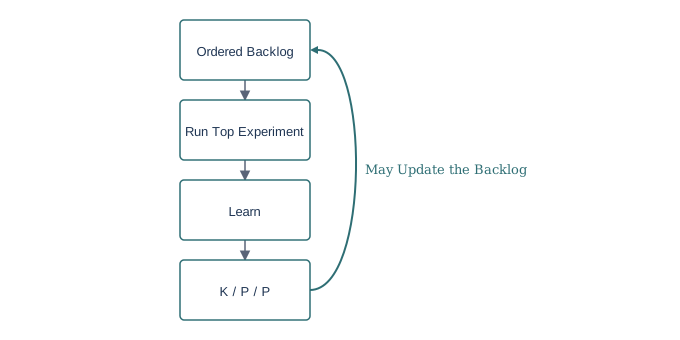
Step 3 is not a checklist with a finish line. The improvement backlog is alive throughout the cycle, ordered by priority. The next experiment is the top item. Each experiment produces learning. Learning reprioritizes the backlog. New experiments emerge. Old ones get killed. The backlog at the end of a cycle is not the backlog the cycle started with.
Kill/Pivot/Persevere is the decision point that drives this loop. Each call may update the backlog: Kill removes the item, Pivot reshapes it, Persevere may leave the priority order intact. Whatever ordering the backlog has at the end of an experiment, the top item runs next.
VAP at Different Altitudes
The three steps don’t change at different scales. The cast, scope, and cadence do.
Team altitude: retrospectives and targeted issues
VAP at team altitude takes two common shapes.
Recurring improvement runs inside the team’s retrospective rhythm. Cadence-driven. Outcomes target broad improvement to how the team works: cycle time, defect rate, context switching, handoff friction. The focusing visual represents the team’s current work flow: a kanban board, a value stream map of the team’s lane, an Effort by Impact matrix when no domain visual fits.
Targeted issue runs ad-hoc, triggered by a specific problem: a quality spike, a recurring missed estimate, a customer complaint pattern, a post-incident review. Outcomes target the specific issue: “defect rate on Module X back below baseline,” “dependency on Team Y no longer adds a sprint of latency.” The focusing visual represents the issue itself, not the workflow: a fishbone or 5-whys structure, the slice of the value stream where the issue lives, an incident timeline, a Pareto of failure modes.
In either shape, the three steps are the same. The team picks a small number of experiments. The team itself is the deciding body. Kill/Pivot/Persevere happens at the next retro for recurring improvement, or as experiments resolve for the targeted issue.
Value stream altitude: flow improvement and targeted constraints
When the improvement target spans multiple teams within a value stream, or coordination across interdependent value streams, the cast expands. The two shapes here are ongoing flow improvement and a focused response to a surfaced constraint.
Ongoing flow improvement runs on a cadence aligned to the value stream’s planning rhythm. The value stream leadership group, supported by the people doing the work, runs VAP as a recurring practice. Outcomes target overall flow: lead time, throughput, customer-perceived latency, defect rate at integration boundaries. The focusing visual is a value stream map covering intake through release; for cross-stream work, a multi-stream view that surfaces the integration points and hand-off boundaries between dependent streams. The series provides a pre-built value-stream-altitude visual that names the friction patterns most common at this scale.
Targeted constraint runs ad-hoc, triggered by a specific bottleneck or flow problem: integration latency between two teams spikes, the release pipeline drops a measurable fraction of artifacts at a particular stage, a cross-team or cross-stream dependency consistently extends cycle time. Outcomes target the specific constraint. The focusing visual narrows to the relevant slice of flow: a queuing or wait-time analysis, a Theory-of-Constraints view that surfaces the binding constraint, or a dependency map for cross-team or cross-stream coordination issues.
In both shapes, experiments target flow: WIP limits, decision-rights compression, dependency reduction, handoff elimination. The deciding body is the value stream leadership group, or a coordinating body spanning multiple value-stream leadership groups when the scope is cross-stream. Kill/Pivot/Persevere happens on the planning cadence for ongoing improvement, as data resolves for targeted constraint work.
This is the altitude where VAP starts looking less like a retrospective and more like a governance practice, but the mechanism is the same.
Executive altitude: transformation governance and strategic-event response
At the enterprise level, VAP replaces big-bang transformation with portfolio-managed improvement. Two shapes apply: ongoing transformation governance and ad-hoc strategic-event response.
Ongoing transformation governance runs on a quarterly cadence. The Steering Group runs VAP as a continuous portfolio practice. Outcomes are strategic and span multiple value streams: time-to-market, cost-of-delay, capacity for new initiatives, organizational learning rate. The focusing visual is the pre-built executive-altitude visual covering Strategic Planning, Portfolio Governance, Value Realization, and Feedback. The Three Barriers diagnostic and its twenty-three named gaps populate the issue list directly. Experiments are portfolio-scoped: pilot the new quarterly planning process with one value stream for one cycle, pilot the new funding model with one investment. If a pilot fails, you have lost one quarter of one value stream. You have not paralyzed the enterprise.
Strategic-event response runs ad-hoc, triggered by a specific event with strategic implications: a regulatory change with a hard compliance deadline, a major incident that exposed a structural brittleness, a competitive move that demands a positioning response, an M&A or restructuring event. Outcomes target the specific response posture required. The focusing visual is whatever frames the specific event: a regulatory compliance gap analysis, an incident root-cause and recovery-posture map, a competitive positioning canvas, an integration-risk model.
In both shapes, the deciding body is the Steering Group: not a status-reporting body but an investment committee made up of executives who can actually alter the system, change the funding model, waive the compliance rule, restructure the teams. Their job has three parts:
- Kill zombie work. The hardest thing for an organization to do is stop. The Steering Group exists to explicitly kill improvement initiatives that aren’t producing results, freeing capacity for new experiments.
- Remove systemic blockers. When an improvement owner reports “Legal won’t approve the new process,” the Steering Group doesn’t note it in the minutes. They pick up the phone. They own the cross-boundary friction no single team can resolve.
- Maintain the outcome anchor. Every action ties back to the outcome established in Step 1. When an action becomes activity for activity’s sake, they cut it.
Working at portfolio-experiment scope also protects against Transformation Fatigue: you aren’t inflicting a massive, unproven change on everyone at once, you are proving value in small increments and scaling what works.
Why VAP Works Differently
Four differences distinguish VAP from the improvement approaches most organizations have already tried.
Outcomes come first, not solutions. Most efforts begin with a predetermined answer: adopt this practice, install this tool, restructure around this model. VAP begins by asking what result you’re trying to achieve. The outcome anchors everything that follows. Without it, improvement becomes activity without direction.
Discovery is structured, not chaotic. The focusing visual prevents blank-slate drift and first-speaker bias. Brainstorming grounded in the actual domain produces specific, prioritizable issues, not a list of grievances.
Action creates an execution mechanism, not just a list. Ownership is assigned. Cadence is established. Adaptation is built in. The backlog is living. Working it surfaces new actions that feed back into prioritization. Improvement becomes continuous, not episodic.
The same pattern works at every scale. Executive teams, value stream groups, and individual teams use the same three steps. The cast, scope, and cadence change. The mechanism does not. A VAP cascades up and down an organization without needing to be re-invented at each altitude.
What VAP Is Not
VAP is not a methodology to replace whatever the organization is currently running. Teams running Scrum keep running Scrum. Portfolios using SAFe keep using SAFe. VAP overlays an improvement rhythm on whatever is already in place. The improvement target is the way the organization currently works, including its current methodology.
VAP is not a big-bang transformation in disguise. The whole point of the cadence, the portfolio experiments, and the Kill/Pivot/Persevere discipline is to operate at small, fast, reversible increments. Programs that try to “do VAP” enterprise-wide in a quarter have missed the design.
VAP is not consulting-engagement-shaped. It is run by the organization, in the organization, on the organization’s actual work. A consultant might facilitate the first one or two cycles to model the pattern. After that, the rhythm has to belong to the people inside the system.
What VAP Is For
VAP is the engine that turns a diagnostic frame into measurable movement. Pair it with the Three Barriers diagnostic, and the recognition pattern feeds the improvement backlog directly. Pair it with Latency Load at the work-item level, and the components of Latency Load become the issues discovery surfaces. The framework names what is broken. VAP makes it possible to do something about it.
Diagnosis without an intervention mechanism produces despair. The mechanism without diagnosis produces motion. The pair is the engine.
Related Framework Concepts
The Three Barriers. The diagnostic frame VAP operates on. The barriers and their twenty-three gaps feed the discovery step of every enterprise-altitude VAP cycle.
Latency Load. The operational target VAP attacks at the work-item level. WIP limits, smaller batches, and decision-rights compression are the highest-leverage actions VAP surfaces, and each one reduces Latency Load directly.
Value Increments. The operating unit at the strategic altitude. Each VAP cycle at the executive level governs a portfolio backlog populated with value increments, not initiatives. Kill, Pivot, or Persevere is called at the increment level, where the cost of being wrong is one quarter, not one fiscal year.
Focusing Visuals. The pre-built scaffolds that structure discovery at executive, value-stream, and team altitudes. Each one is matched to the friction patterns most likely to surface at that scale.