Diagnostic Frame
The Three Barriers
Twenty-three gaps. Three structural patterns. One self-reinforcing system. The diagnostic lens that names what the transformation program could not see.
The Frame
Enterprise agility doesn’t fail because organizations don’t try. It fails because the dysfunctions that prevent it are diagnosed in the wrong vocabulary, attacked in isolation, and treated as cultural problems when they are structural.
Applied Agility names twenty-three specific, diagnosable dysfunctions that prevent enterprises from achieving agility. Not vague mindset problems. Concrete structural failures in how work gets identified, funded, prioritized, approved, and measured.
Those twenty-three gaps don’t scatter randomly. They cluster into three distinct barriers. Each barrier attacks agility differently. Each leaves different fingerprints. Together they form a diagnostic lens for seeing where the organization is actually broken, not where the framework’s treasure map told leadership to look.
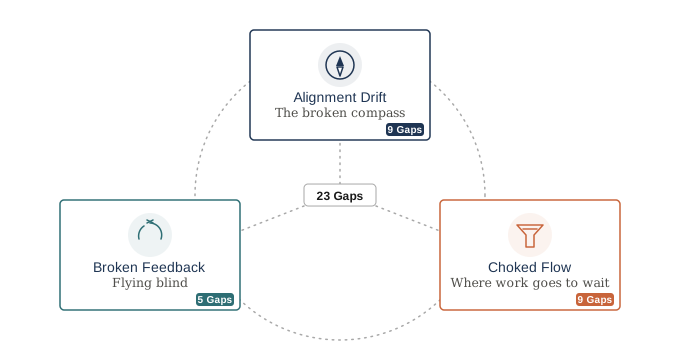
Barrier 1: Alignment Drift
The compass is broken. Leadership has a strategy. Teams cannot act on it. Not because they are ignoring it. Because it never reached them in usable form.
Alignment Drift shows up when executives talk outcomes while teams focus on tasks. When the portfolio is full of funded projects but nobody can articulate which customer problem each one solves. When “value” means something different in the boardroom than it does in the team room. The signature symptom is that everyone is busy, everyone believes they are working on the right thing, and customers still aren’t getting what they need.
Nine gaps live under Alignment Drift. They range from foundational corruptions of the signal (Incentive Misalignment, Language Drift, Delivery-as-Success, Motion-as-Progress) to structural constraints on capacity and clarity (Capacity Denial, Portfolio Fog) to frictional drags on day-to-day execution (Horizon Collapse, Strategy Vapor, Priority Collision).
Barrier 2: Choked Flow
The system is full. Every team is allocated. Every team member is one-hundred-percent utilized. Every iteration is planned. And the backlog keeps growing, cycle times keep stretching, and the gap between started and delivered keeps widening.
Choked Flow is what happens when the organization’s demand for work exceeds its capacity to complete it. The portfolio keeps authorizing. The intake process keeps accepting. The system keeps filling. Throughput doesn’t scale with input; it degrades. Work piles up in queues waiting for approvals, dependencies, and decisions that never come. Teams stay busy. Value stays stuck. The signature symptom is that work enters fast and exits slow. Starting new things is easy. Finishing anything is hard.
Nine gaps live under Choked Flow. The Project-Funding Trap forces constant re-staffing and destroys team stability. Decision-Rights Fog escalates routine choices because nobody knows who is authorized to say yes. Silo Survival, Missing Runway, Governance Drag, Change Saturation, Capacity Illusion, Risk-Language Mismatch, and Hidden Debt fill out the cluster. Each one constricts the pipes that carry value from idea to customer.
Choked Flow is the barrier most directly connected to Latency Load. The structural mechanics of choked flow at the work-item level generate the components of Latency Load that consume capacity.
Barrier 3: Broken Feedback
You are flying blind. The dashboards are green. The reports are comprehensive. And none of it tells you whether customers are actually getting value.
Broken Feedback is what happens when the organization optimizes for measurement instead of learning. Metrics multiply. They measure activity, not impact. Teams ship work. Nobody tracks whether usage changed. Decisions get made. They are based on internal opinion, not external evidence. The signature symptom is dashboards full of numbers while leadership still argues about what’s working. The answer to “how do we know this matters?” is a confident assertion, not observable data.
Five gaps live under Broken Feedback. Customer Distance is foundational: teams navigate by filtered reports instead of direct observation of users. Data Illiteracy caps the organization’s ability to interpret the data it does have. Leadership Absence, Evidence Stalemate, and Experiment Prohibition complete the cluster. Each severs the connection between action and learning.
The Severity Hierarchy
Not all gaps are equal. The diagnostic loses force when every gap is treated as roughly the same kind of problem. The hierarchy is the second cut.
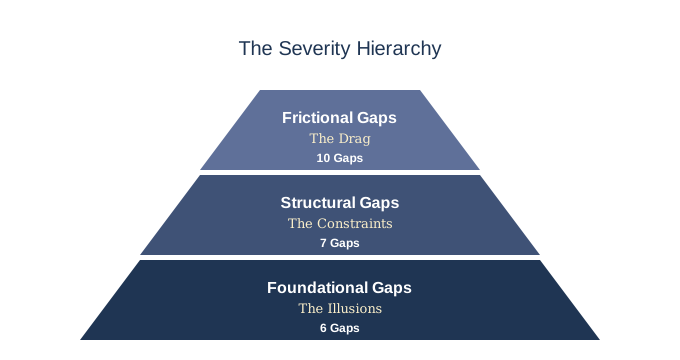
Foundational gaps are the most severe. When these exist, the organization is operating on false signals. Incentives contradict strategy. Success is defined in ways that don’t connect to customer value. Teams navigate by filtered reports instead of reality. Process improvement cannot fix these. The underlying system is lying. Six gaps across the three barriers sit at this tier. Until they are addressed, every other fix is built on sand.
Structural gaps are hard ceilings. They don’t slow you down; they prevent adaptation. Load-bearing walls. Rigid approval chains. Funding models that force batching in a world that demands flow. Seven gaps sit at this tier. No amount of team-level improvement overcomes a structural constraint.
Frictional gaps are the tax on execution. They don’t stop the car, but they force you to drive with the parking brake on. Individually each one seems manageable. Collectively they burn out talent and erode margins through waste, delay, and confusion. Ten gaps sit at this tier. This is where efficiency evaporates.
Foundational gaps corrupt signals. Structural gaps cap speed. Frictional gaps drain energy. Read the inventory in that order and the priorities sort themselves.
The Vicious Cycle
The barriers do not operate in isolation. That is the central trap.
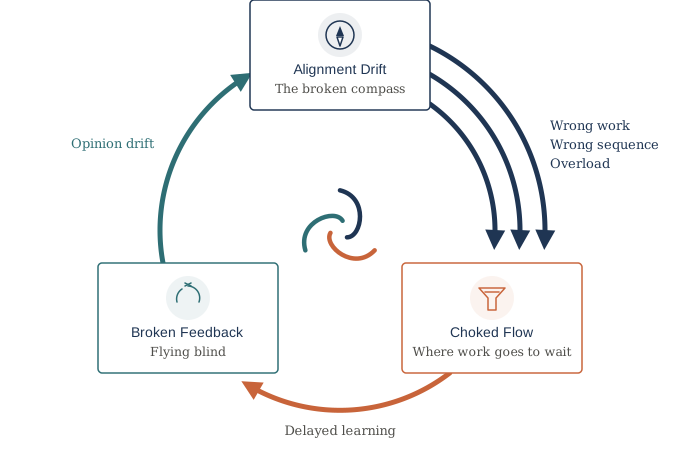
Fix Alignment Drift while flow remains choked, and the backlog of wrong work already in the system keeps moving. Wrong sequences already locked in governance queues keep consuming capacity. By the time clarity reaches teams, the damage is done.
Unclog flow while feedback stays weak, and faster delivery just accelerates the rate at which you ship the wrong things. Learning still arrives too late to matter.
Strengthen feedback while misalignment persists, and better signals land in a system that can’t act on them. The next planning cycle has already locked priorities based on last quarter’s opinions.
The barriers regenerate each other. Most transformation programs attack one barrier at a time, achieve measurable local improvement, and watch the gains evaporate as the other two barriers reassert themselves. The failure isn’t execution. It is the assumption that the barriers operate independently. They don’t.
You aren’t fixing a machine. You are healing an ecosystem.
The Amplifiers
Structural barriers don’t exist in a vacuum. They exist in a culture.
Some organizations have terrible processes and still deliver through high trust and heroism. Others have perfect frameworks and grind to a halt because everyone is terrified of being wrong. The difference is the amplifiers: environmental conditions that determine how hard it will be to fix the barriers.
Executive Team Misalignment. The C-suite doesn’t function as a team. When executives can’t align on trade-offs, conflicting priorities cascade down as “everything is Priority One.” You cannot align the enterprise when the top isn’t aligned.
Transformation Fatigue. Scar tissue from past failed transformations. The workforce has learned that waiting outlasts any initiative. Each abandoned effort makes the next one harder to launch.
Middle Management Squeeze. Managers caught between new expectations and old incentives become antibodies. Alignment messages get reinterpreted at each level. Feedback gets sanitized before traveling up. The transformation asks them to dismantle the structures that give them status.
The AI Accelerant
The diagnostic works on AI deployment, too. No modification required.
Every organization deploying AI at scale is experiencing the three barriers right now, whether or not they have named them. AI doesn’t create new categories of dysfunction; it pressurizes the existing ones. Alignment Drift under AI pressure looks like every department buying its own AI capability against its own objectives, with no enterprise-level outcome framework. Choked Flow under AI pressure produces the specific paradox where teams work faster and the organization delivers slower; AI generates output at machine speed while governance still operates at human speed. Broken Feedback under AI pressure gets louder, not clearer; AI dashboards can produce more metrics per hour than a leadership team can absorb in a quarter.
The lens is the same. The urgency is higher. AI compresses the timeline for consequences. Gaps that took years to produce visible damage now produce it in months.
How the Diagnostic Is Used
The barriers are not a checklist. They are a frame for seeing.
Read the inventory of twenty-three gaps with the organization in mind. Notice which gaps feel familiar. Notice where they cluster: one barrier heavy with familiar gaps tells a different story than gaps scattered evenly across all three. Notice which severity tier keeps appearing.
Diagnosis precedes action. The diagnostic is the input to the Value Acceleration Process, which converts the recognition pattern into a working improvement backlog with ownership and rhythm. Diagnosis without an intervention mechanism produces despair. The mechanism without diagnosis produces motion. The pair is the engine.
The Twenty-Three Gaps
The full inventory of named gaps, by barrier and severity tier.
| Barrier | Gap | Severity |
|---|---|---|
| Alignment Drift | Incentive Misalignment | Foundational |
| Alignment Drift | Language Drift | Foundational |
| Alignment Drift | Delivery-as-Success | Foundational |
| Alignment Drift | Motion-as-Progress | Foundational |
| Alignment Drift | Capacity Denial | Structural |
| Alignment Drift | Portfolio Fog | Structural |
| Alignment Drift | Horizon Collapse | Frictional |
| Alignment Drift | Strategy Vapor | Frictional |
| Alignment Drift | Priority Collision | Frictional |
| Choked Flow | Project-Funding Trap | Foundational |
| Choked Flow | Silo Survival | Structural |
| Choked Flow | Decision-Rights Fog | Structural |
| Choked Flow | Missing Runway | Structural |
| Choked Flow | Governance Drag | Structural |
| Choked Flow | Change Saturation | Frictional |
| Choked Flow | Capacity Illusion | Frictional |
| Choked Flow | Risk-Language Mismatch | Frictional |
| Choked Flow | Hidden Debt | Frictional |
| Broken Feedback | Customer Distance | Foundational |
| Broken Feedback | Data Illiteracy | Structural |
| Broken Feedback | Leadership Absence | Frictional |
| Broken Feedback | Evidence Stalemate | Frictional |
| Broken Feedback | Experiment Prohibition | Frictional |
Each gap has a recognition pattern, a root cause, a business cost, and an intervention strategy. Those are the working depth of Book 1.
Related Framework Concepts
Latency Load. The structural manifestation of Choked Flow at the work-item level. The mechanism by which delay generates new work.
Value Acceleration Process. The intervention engine that converts the diagnostic into a working improvement rhythm.
Value Increments. The portfolio-altitude operating unit that lets an organization act on Alignment Drift and Choked Flow without restructuring entire initiatives. Without an increment-sized unit, portfolio adjustment is an extraordinary intervention. With it, adjustment becomes a routine quarterly move.