Strategy dies in the gap between the boardroom and the team room.
You approved the transformation. You funded the initiatives. You hired the coaches. The results never arrived.
The gaps are upstream. Unclear outcomes. Funding tied to projects instead of value. Decision latency that strangles feedback. Governance architectures that reward the behaviors killing flow. Most books hand executives either high-altitude philosophy or a team-level framework manual. Neither helps a leader staring at a unique, messy constraint that doesn't fit the textbook.
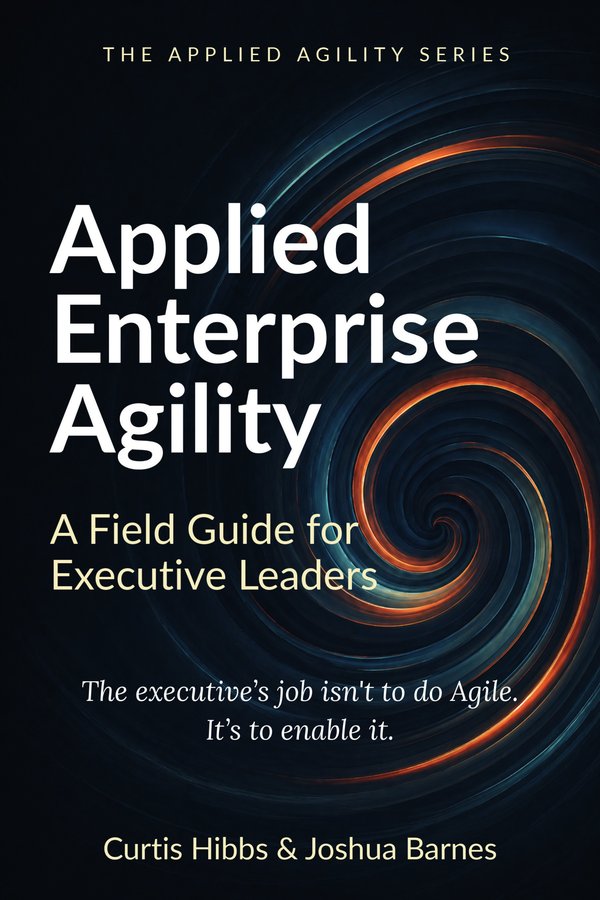
Applied Enterprise Agility is the missing field-grade manual. It shifts the executive's role from Agile Sponsor to System Architect. It diagnoses the three barriers (Alignment Drift, Choked Flow, Broken Feedback) and the 23 specific gaps that silently kill strategy execution. It delivers the Value Acceleration Process: a scalable, iterative alternative to the big-bang transformation that keeps failing.
Budget the team and fund the increment. Diagnose the drag. Architect the flow.
Short on theory. Long on action. Read it on Sunday, fix the flow on Monday.
What's Inside
Part 1 names the problem. The Three Barriers framework, the 23 underlying Gaps, and the diagnostic vocabulary that turns "the transformation isn't working" into specific, fixable system defects.
Part 2 delivers the intervention model. The Value Acceleration Process (VAP) is an iterative diagnostic-and-improvement cycle that meets your organization where it is. No big bang. No methodology swap. No restructuring before you understand the dysfunction. Diagnose the drag, architect the flow, validate, repeat.
Part 3 puts the leader to work. Quick-start moves, focusing visuals for VAP discovery sessions, and the concrete first move you can make on Monday morning to start changing the system instead of the symptoms.
Companion Content
The book references three companion pages on this site for content that works better in a web format than in print.
- Implementation Guidelines. Starting points and guiding principles for your transformation. Not a prescription. A compass for the early moves.
- Focusing Visual Reference. The executive-level, value-stream-level, and generic Effort by Impact visuals used to structure VAP discovery sessions. Full-resolution renders.
- Sources and Citations. Citations and source URLs for every statistic and research finding cited in the book, organized by chapter.
Want the 30-Minute Version First?
The Executive Summary Edition is a compressed reconnaissance briefing for leaders who want the diagnosis before they commit to the full read. Same diagnostic frame. Same intervention model. Working executive's attention budget.